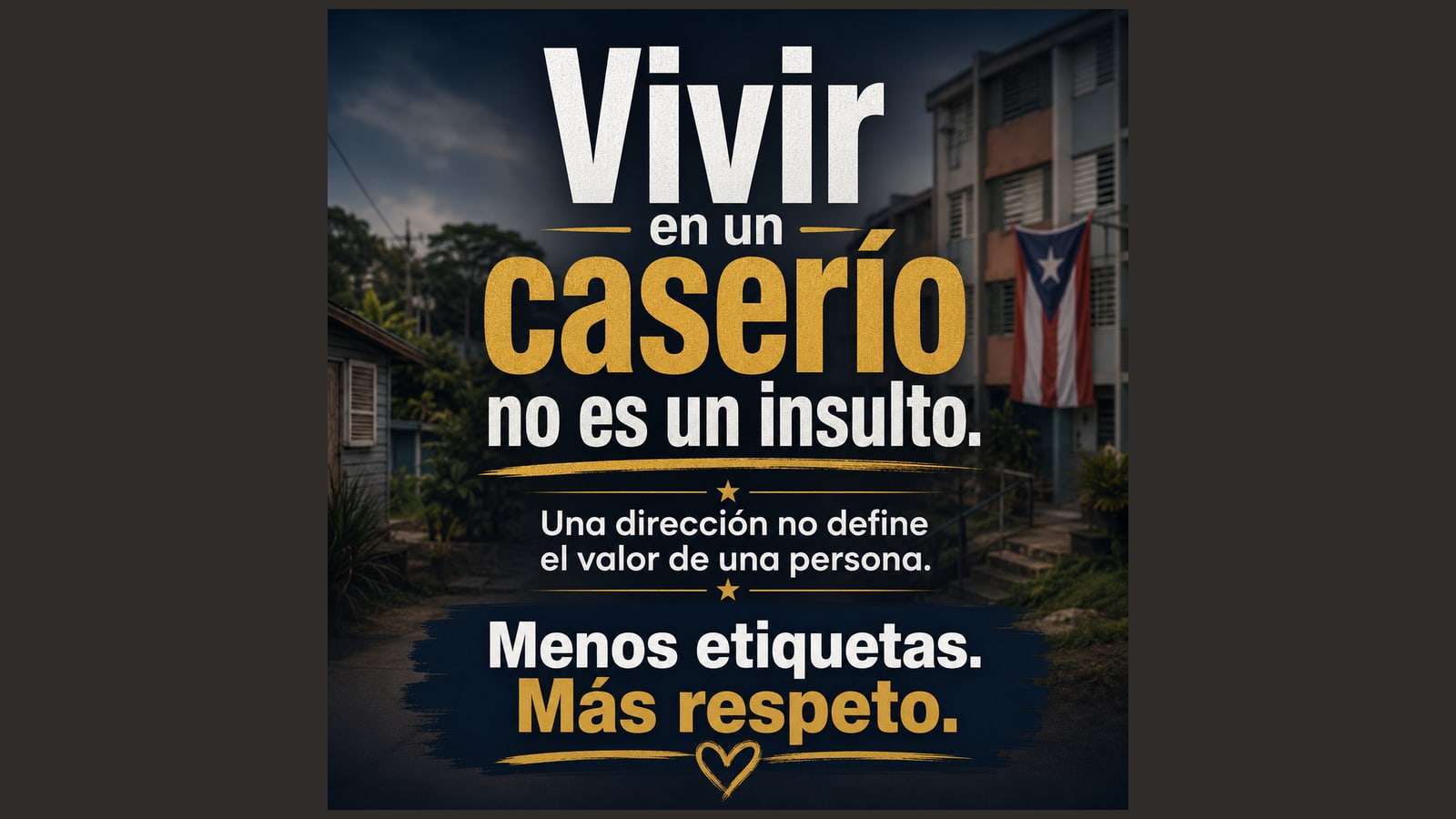
An address doesn't define a person's worth. A reflection on prejudice toward those living in Puerto Rico's public housing communities — and what we reveal when we comment.
It all started with a real estate post. As often happens on social media, some people criticized the property, its price, its appearance or its location. That comes with putting a property out in public.
We can think a house is overpriced. We can say we don't like it. We can say we'd live there or that we'd never buy it. Having different opinions is fine.
But among the comments something started to appear that caught my attention far more than any critique of the property: people using the word “caserío” dismissively, as if living in public housing automatically made a person less educated, less responsible, or worth less.
And at that point the conversation stopped being about real estate. It became a conversation about how we look at our own people.
A property can be criticized. A person shouldn't be belittled for where they live.
In Puerto Rico there are public housing communities in virtually every region. And inside those communities exactly what happens everywhere else in the country happens: there are families.
There are mothers who get up before dawn to work. Fathers trying to give their children a future. Students dreaming of becoming doctors, teachers, engineers, artists, entrepreneurs or professionals. There are nurses, shopkeepers, athletes, musicians, elders, people who work every single day — and young people still figuring out what they want to do with their lives.
Are there problems too? Of course. Just as there are problems in gated developments, in condominiums, in rural communities, in middle-class areas, and even behind the gates of million-dollar properties. The behavior of some people should never be used to define an entire community.
An address doesn't determine the values you were raised with
Something that struck me after posting that message were the testimonies. People started telling me: “I grew up in public housing.” “My best memories were there.” “My mom raised us there.” “I studied, I prepared myself, and today I'm a professional.” “My neighbors were like family.”
Those testimonies matter. But there's something I also want to make clear: a person doesn't need to become a professional, an entrepreneur, or move to a nicer development to prove they deserve respect.
Dignity isn't earned after reaching a certain income level. Dignity already exists. A person deserves respect because they are a person.
Money doesn't make us better human beings either
Sometimes we confuse economic progress with personal superiority. They're not the same. A bigger house doesn't mean better values. Living in a nicer development doesn't guarantee good parenting. An expensive car doesn't produce empathy. And having more money than someone else definitely doesn't grant us the right to look down on them.
Financial stability can improve many circumstances in our lives. But character shows up somewhere else: in how we treat those who can give us nothing, in how we speak about those who live differently, and in how we teach our children to relate to other people.
Social media also reveals who we are
Social media gave us something extraordinary: a voice. But having a voice also brings responsibility. Behind a screen it's very easy to write something we'd probably never say looking another person in the eye. A comment takes seconds to write, but it can reveal prejudices we've carried for years without ever questioning them.
That's why this conversation shouldn't turn into a fight between those who live in public housing and those who don't. That would be exactly the opposite mistake. We don't need to swap one label for another: we need to learn to drop the labels.
As a real estate broker I see Puerto Rico from many realities
My work takes me into completely different communities. I see large properties, small houses, apartments, land, gated developments, countryside, coastal sectors, humble communities and luxury properties.
And after visiting so many places, something always turns out to be true: a house is a structure. It can have concrete, blocks, wood, windows, doors and a roof. But none of that tells me what kind of person lives inside.
I've met extraordinary people in very simple homes. And an expensive property has never been a guarantee of finding a better person behind the door.
Be careful what we teach our children
For me, this may be the most important part. Our children hear how we speak. They hear us joke about certain communities. They hear us associate poverty with a lack of education. They hear us use where someone lives to describe them negatively. And little by little they can start believing some people deserve more respect than others.
That's where our responsibility lies: teaching them that we never know the battle the person in front of us is fighting. Today we may have stability. Tomorrow our situation can change. Life turns in many directions. And the very help we think we'll never need today could be exactly what our own family needs tomorrow.
A word shouldn't become a synonym for a person
When someone uses that word dismissively, they're no longer simply describing a place: they're turning thousands of different people into a single stereotype. And no human group is that simple.
That's why I prefer to speak of public housing communities, communities and families. Because behind every building there are stories we don't know. There are sacrifices. Dreams. Hardships. Victories. Good people. And also imperfect human beings. Exactly like anywhere else in Puerto Rico.
We can criticize without humiliating
I don't want this conversation to be read as nobody being allowed an opinion. Quite the opposite. We can debate. We can talk real estate. We can analyze prices. We can discuss social problems. We can even talk about the real challenges some communities face.
But a serious conversation doesn't need to humiliate anyone. We can talk about problems without turning the people who live there into the problem.
Puerto Rico needs fewer labels and more respect
Maybe that comment that started out being about a property ended up opening a far more important conversation. And if something good can come from it, I hope it's this: an address does not determine a person's worth.
- ✓Not the housing community they live in
- ✓Not the development
- ✓Not the condominium
- ✓Not the neighborhood
- ✓Not what they paid for their house
- ✓Not how much money they have in the bank
Our humanity is worth far more than our mailing address. So yes — we can criticize a property. We can criticize a price. We can even completely disagree. But let's not turn our own people into a slur.
🇵🇷 Puerto Rico needs fewer labels and a lot more respect.
I want to hear your story
If you grew up in or live in public housing in Puerto Rico and there's something you'd want others to understand about your community, I'd like to hear from you. What memory, person or lesson marked your life there the most? Sharing our stories is also a way to break stereotypes.
Ready for the next step?
Talk to Kelvin