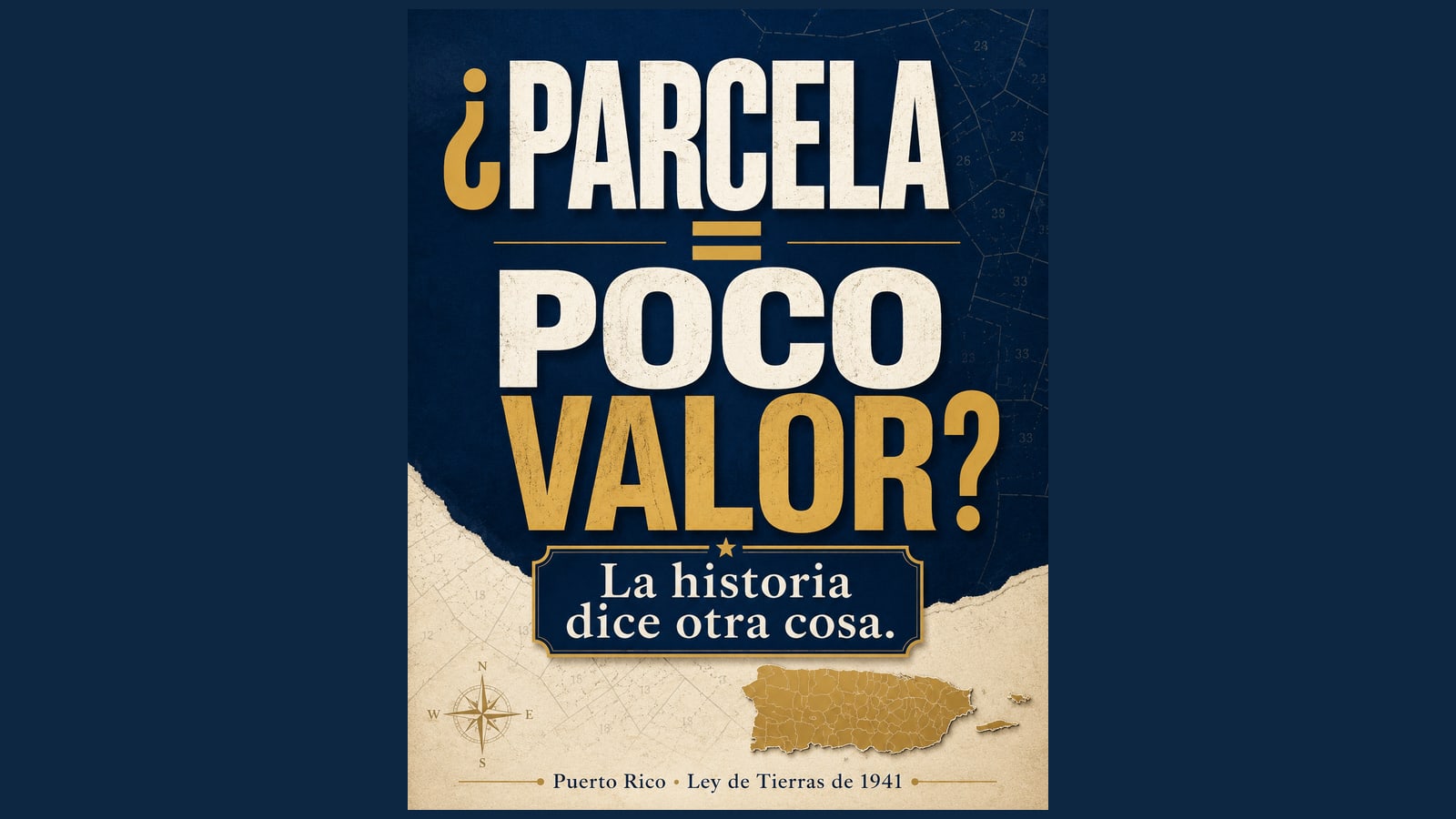
In Puerto Rico people still say “that's in the parcelas” to describe certain communities. But few know the history of the 1941 Land Act, the free usufruct grants, and how many of those communities evolved over more than 80 years.
For years in Puerto Rico we've heard expressions like “that's over in the parcelas” or “that looks like parcela.” And often they're not simply describing a location: they carry a connotation meant to say a place is less desirable, that properties there are necessarily worth less, or even that the people who live there belong to a certain social class.
But there's a problem with that perception: the word “parcela” means none of that. In fact, when we understand where many of the communities known as “Las Parcelas” came from, we find a completely different story — one of access to land, housing, agrarian reform, families building homes, and communities that have evolved for more than eight decades.
And some of those areas that began that way sit today in real estate markets that could never be described simply as “low value.”
First: what is a parcela, really?
From a cadastral standpoint, a parcela is not a type of community or a socioeconomic classification. Puerto Rico's Cadastre Act defines a parcela as a cadastral unit made up of a physically delimited portion of land. In other words, technically we're talking about identified, bounded land — not how much money its owner has or what a house built on it is worth.
That's why we use parcel numbers and cadastre numbers every day in real estate. A parcela can hold an $80,000 home. It can just as easily hold an $800,000 property.
The word by itself is not an appraisal.
So why does Puerto Rico have so many communities called “Las Parcelas”?
For this we go back to 1941. That year Puerto Rico's Land Act was approved, one of the most important pieces of the island's agrarian reform. Puerto Rico then had a heavy concentration of farmland and thousands of rural families who worked the land but did not own the ground they lived on. The law itself used the term “agregados” to identify many of those families.
Title V of the Land Act created a program specifically aimed at establishing rural communities and letting those families have land where they could permanently build their homes. That's where much of the story we still call “Las Parcelas” begins.
Were they given away?
An important distinction is needed here. Article 76 of the Land Act originally established the free grant of parcels in usufruct to eligible families. The law provided that the Administration could grant, free of charge in usufruct, land that would normally range from a cuadro up to three cuerdas, depending on the subdivision and local circumstances.
That means it wasn't necessarily an immediate transfer of fee-simple title: it was the right to use that land to establish the family home under the program's conditions.
Decades later came another major change. In 1969, Puerto Rico passed Act No. 35 to let eligible usufructuaries acquire title to their parcels. That law's statement of motives noted that by then roughly 75,000 families had received parcels or lots under the program. The legislation allowed certain beneficiaries to acquire fee-simple ownership for a nominal price; the program's rules contemplated $1 sales for usufructuaries who met the requirements.
That helps explain why today we find so many private, titled properties — with entire generations of families — inside communities that still carry the name “Parcelas.”
This happened across Puerto Rico, not in one town
The program's reach was enormous. Official Department of Education materials on the agrarian reform note that by 1959 there were 304 rural parcela communities under the Title V program.
That's why we find communities called Parcelas from the west to the east of Puerto Rico. Moca, Quebradillas, Rincón, Cabo Rojo, San Germán, Loíza, Ceiba and many other municipalities still have sectors or communities tied to that model of rural subdivision and housing.
Even modern planning documents still identify these communities. Quebradillas' Territorial Plan, for example, recognizes Parcelas Cacao within one of its urban zones, while government documents still identify communities such as Parcelas Stella in Rincón and Parcelas Sabana Eneas in San Germán.
Cabo Rojo: an example of how a community can transform
Cabo Rojo shows very clearly why using the word “parcela” as a synonym for low value can lead to wrong conclusions. Cabo Rojo's own Territorial Plan identifies several traditional settlements resulting from re-parceling, including the Parcelas of Boquerón, Combate, Corozo, Pole Ojea, Betances/Las Arenas, Samán and Las Palmas.
Now think about some of those names. Boquerón. Combate. Today we're talking about tourist areas, second homes, vacation rentals, beach access and real estate markets that include properties worth hundreds of thousands — and even millions — of dollars.
Right now, for instance, the broader El Combate market has properties listed around $839,000, $995,000, $1.2 million and up to $3.6 million. This doesn't mean those specific properties are the original parcels from the 1941 program, but it shows how much an area's real estate environment can change over the decades.
Rincón is another interesting case
In Rincón the well-known Parcelas Stella community still exists, next to one of the municipality's coastal areas. And here we can see directly how the word “Parcelas” and today's market coexist without any contradiction.
A roughly 3,000-square-foot home, described in the MLS as located in “Parcelas/Stella” and beachfront, was marketed at $899,000. Recent area sales data also records a property identified as Parcela 34, Calle 8, Rincón, sold for $545,000 in November 2025.
Again: a single transaction doesn't determine an entire community's value. But it does show why simply saying “it's parcela” is not serious real estate analysis.
And it isn't only the west
In Loíza there's Parcelas Suárez. A property specifically identified as 9 Parcelas Suárez, Calle 10 is recorded as sold for $395,000 in December 2024. In Ceiba the area known as Parcelas Machos remains, while around that market we find homes and developments currently listed in the $400,000, $500,000 and higher ranges.
These examples don't mean every property in “Las Parcelas” is expensive. Nor that all these communities share the same conditions. What they show is something else: a community's historical origin or name does not automatically determine its current real estate value.
The market changes faster than stereotypes
A community can begin 70 or 80 years ago as a rural project. Then a road arrives. Then water. Electricity. Businesses. Schools. Hospitals. Tourism. New developments. Second homes. Airbnb. Greater demand.
And suddenly that land, which decades ago had very little commercial value, sits five minutes from a tourist beach, near a main avenue, or surrounded by new development. Land doesn't stay economically frozen in the year it was subdivided. Our perception, however, often does.
That's where the problem starts: we keep describing a community with a mental image that may belong to the Puerto Rico of 1950, while trying to determine a property's value in 2026.
Careful: not every “Parcelas” shares the same origin
This is also important to clarify. We shouldn't make the opposite mistake of assuming every sector carrying the word “Parcelas” was necessarily created under Title V of the 1941 Land Act. Puerto Rico has had different processes of segregation, subdivision, re-parceling and public programs over many decades.
So if we want to know a particular community's exact origin, we have to research its documents, plats, deeds, registry history and planning records. The 1941 story explains a fundamental and enormous part of why the term became so common in Puerto Rico, but each community can have its own history.
So how is a property's value actually determined?
This is where we have to separate history from real estate value. As a broker, I can't determine a property's value because someone tells me “it's in the parcelas.” Nor because they say “it's in an urbanización.”
To evaluate a property properly we have to look at, among other things:
- ✓Comparable sales in the area
- ✓Specific location and access
- ✓Lot size and structure condition
- ✓Land classification and zoning
- ✓Flood risk and available infrastructure
- ✓Title and registry status
- ✓Market demand and the property's particular features
Two houses 500 meters apart can have completely different values. So can two properties within the same community. That's why stereotypes are poor substitutes for data.
Perhaps the most interesting part isn't what they're worth today
There's something about this history I personally find even more powerful. Many of those parcels began with a family that simply wanted a place to build their home. There they raised children. The children built. Then came the grandchildren. Houses were expanded. Some properties were sold. New families arrived. And eight decades later many of those communities still stand.
Seen that way, the Parcelas aren't only a story about land: they're a story about social mobility, ownership, family, and how one opportunity for access to land can transform generations.
Next time you hear “that's parcela…”
It may be worth asking: what does it actually mean? Are we technically describing a piece of land? Are we using a community's historical name? Or are we repeating a perception we've never stopped to question?
Because one thing is certain: “parcela” is not a social class. It's not an appraisal either. And two words definitely don't replace a serious analysis of a property. Communities change. Puerto Rico changes. The market changes. And sometimes the last thing to change are our stereotypes.
Do you know a “Parcelas” in Puerto Rico?
I want to keep documenting this part of our history. If you grew up in, live in, or know a community called Las Parcelas, send me the municipality and the community's name. I'd like to know how it began, how it has changed, and what people should know before judging it by its name alone. Puerto Rico's history is also written in its communities. 🇵🇷
References
- ✓Puerto Rico Land Act (1941) — Title V and Article 76 (free grant in usufruct)
- ✓Act No. 35 of 1969 — acquisition of title by eligible usufructuaries
- ✓Puerto Rico Cadastre Act — definition of a parcel as a cadastral unit
- ✓Cabo Rojo Municipal Territorial Plan — traditional settlements from re-parceling
- ✓Quebradillas Territorial Plan and government documents identifying parcela communities
- ✓Department of Education materials on the agrarian reform (304 communities by 1959)
Ready for the next step?
Talk to Kelvin