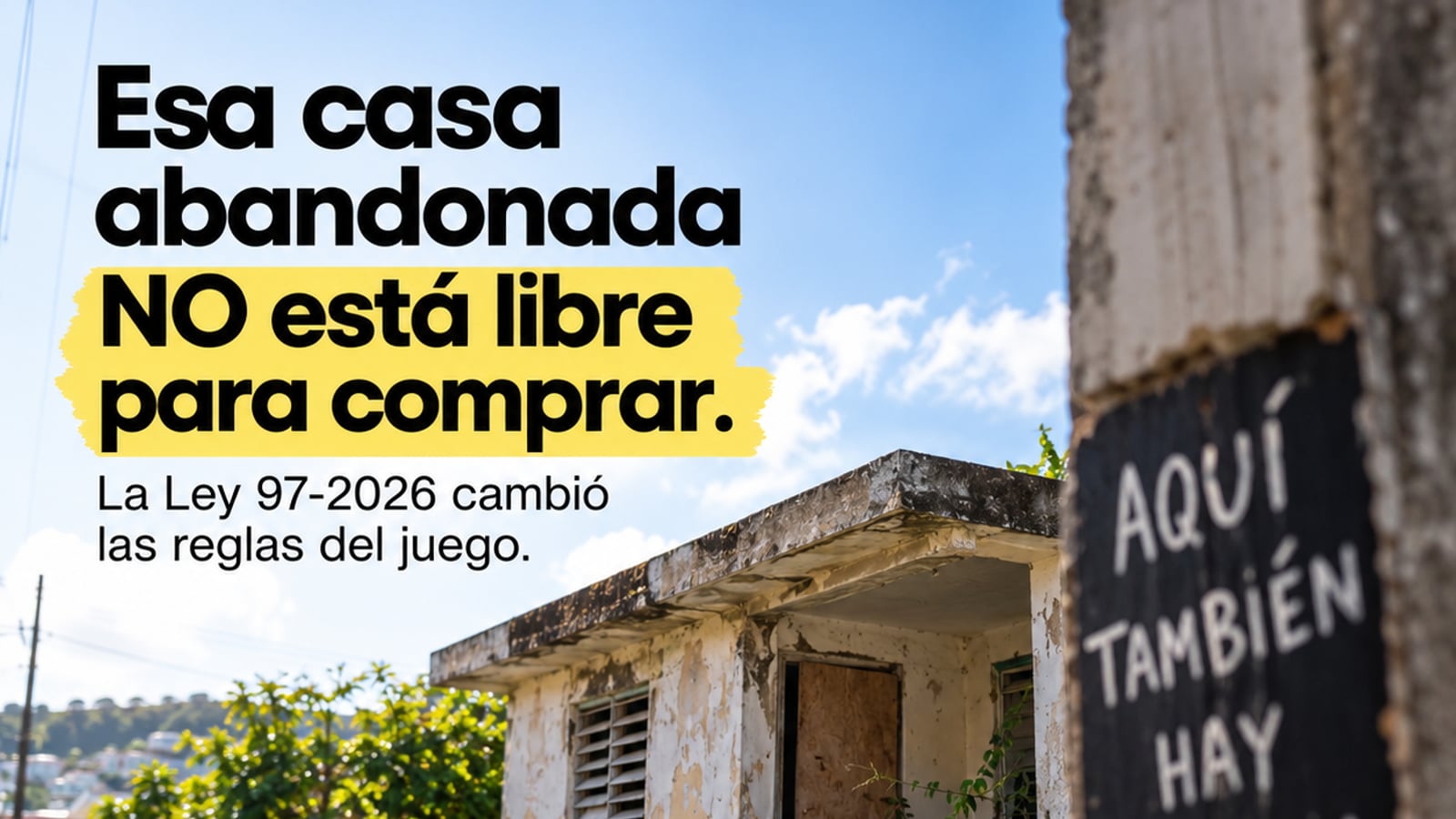
An abandoned house isn't automatically for sale. What to check about priority, inheritance, CRIM debt, costs and rehabilitation before you commit money.
You see a shuttered house, overgrown, the structure falling apart. Maybe you've driven past it for years thinking: «A family could live there».
It's a fair question. But before we talk about buying it, renovating it or investing, one thing has to be clear: a house that looks abandoned is not automatically available to buy. The Municipal Code separates identifying a property, declaring it a public nuisance, and acquiring it for later transfer. Those are different stages, each with its own requirements and rights.
Municipal Code, arts. 4.008, 4.010 and 4.012
Here's what you should know as a buyer, owner, heir or neighbor. Not to promise you a cheap house, but to help you ask better questions before you commit money.
1. What Act 97-2026 is, and what already existed
Act 97 of June 1, 2026 amended several articles of Puerto Rico's Municipal Code. Among other matters, it changed provisions on public nuisances, notices, municipal powers, expropriation and protection of a primary residence. It is not a law dedicated solely to selling abandoned houses.
Official record of Act 97-2026
One important clarification: the summary procedure and the priority for people with limited opportunities to acquire housing were already in Act 114-2024. Act 97-2026 modified that framework; it did not create it from scratch. Nor should it be presented as a blanket ban on every private purchase by investors.
Act 114-2024, art. 8 (see page 19), and Municipal Code, art. 4.012A
So this guide explains the system as it stands in the texts consulted, keeping its different mechanisms apart.
2. Not every run-down house is a declared public nuisance
The legal definition covers abandoned structures and land that, given their condition, are unfit for human use or harmful to public health or safety. It includes ruin, lack of repair, construction defects and accumulated scrap or debris. But what your eyes tell you does not replace the municipal procedure.
Act 97-2026, amendment to art. 8.001
Article 4.008 covers identifying and notifying owners, possessors and interested parties. It sets a 30-day window from notice to object and request a hearing. Article 4.010 governs the final declaration under the circumstances it describes.
Municipal Code, arts. 4.008–4.010
Identified, declared, acquired by the municipality and available for transfer do not mean the same thing. My first question would be: what document proves which stage that property is actually in?
3. Who has priority to acquire a rehabilitable home
Article 4.012A allows a municipality to adopt, by ordinance, requirements for selling or transferring properties acquired by purchase or through the summary procedure, when those buildings can be rehabilitated as homes. It directs the municipality to first consider, where such buyers exist, people whose opportunities to acquire housing are limited in the traditional market. The restriction on benefiting third parties, investors included, is tied to the summary mechanism.
The provision contemplates an exception for those buyers during the first year from the municipal declaration, as the ordinance provides. It also gives the interested citizen one year to secure funds, assistance or other resources, with a possible six-month extension. If the purchase doesn't close once that term runs out, the municipality may sell to third parties, investors included. There is also a disposition scenario when a year passes from the declaration and listing in the inventory with no interested buyers.
None of this is an automatic award or a promise of financing. And those terms shouldn't be added up or calculated without reading the file. My recommendation: ask in writing for the applicable ordinance, the eligibility criteria, and the date from which the municipality counts each term.
4. An occupied primary residence has a specific protection
Subsection 4.010(g) provides that, for purposes of that article, a structure occupied as the primary residence of a possessor exercising dominion over it is not considered a public nuisance. The wording is not limited to «owner with a recorded deed».
That doesn't mean an occupied home is free of every safety rule. The Code has separate procedures for inadequate or dangerous dwellings. You have to identify the rule and the facts of the case before concluding that an intervention is allowed or barred.
Municipal Code, arts. 4.015–4.019
For me it matters not to confuse a family going through hard times with an abandoned property. Bringing communities back and respecting the people already living in them have to go together.
5. Heirs: don't ignore the notices
Article 4.010(e) contemplates awarding a property with heirs to the municipality when more than three years have passed since its declaration as a public nuisance without being claimed. It requires a court order and proof of the corresponding notices. These are not three years from the owner's death.
Subsection 4.010(f) covers a different scenario: when no titleholder or holder of a real right appears to object and more than a year passes from the declaration with no claim. It also requires judicial intervention, notices and evidence of the efforts to locate people. The two scenarios shouldn't be treated as one rule.
Municipal Code, art. 4.012A(b)
6. Expropriating without an initial deposit doesn't erase compensation
The provisions consulted allow certain expropriation actions to begin without depositing money when the complaint is filed. The obligation is triggered by the defendants' appearance in the manner the Code establishes. That should not be described as blanket permission to «take properties without paying».
Municipal Code, arts. 2.018(a)(10) and 4.012A(f)
Article 2.018 also contemplates a five-day term for title to vest in the municipality in the scenario it governs. That is not a promise that a private buyer will receive a house in five days. There are other steps, rights and obligations.
Act 97-2026, amendment to art. 2.018
Separately, article 4.012A(g) sets three years to claim the just compensation determined by judgment. That period is about claiming the court-set amount — not the inherited-property scenario explained above.
Municipal Code, art. 4.012A(g)
7. CRIM, fines and title: don't assume everything is wiped clean
Article 4.010(d) contemplates deducting tax debt when calculating just compensation, and cancelling CRIM debt when title transfers to the municipality under the scenarios it describes. It also addresses fines and municipal cleanup or maintenance costs.
So it isn't responsible to claim across the board that the new buyer inherits every debt, or that every lien disappears. The CRIM provision is not enough to conclude how each mortgage or other claim will end up. My recommendation: review the title study, the certifications and the applicable resolutions or judgments with an attorney before committing funds.
8. The price is not the total cost of bringing the property back
Under article 4.012, the applicant-acquirer must contribute the appraised value plus 10% for the costs and fees of the proceeding. They may also have to cover additional amounts. That 10% is not a mortgage down payment, nor a guaranteed cap on expenses.
Municipal Code, art. 4.012(b)–(d)
My practical approach would be to budget separate line items for acquisition, filings, inspection, design, permits, repairs, utilities and contingency. I'd ask for written quotes and a realistic schedule.
I wouldn't buy because getting in looks cheap. I'd price out what it costs to finish.
9. After you acquire it, there are still obligations
Article 4.014 lets the municipality exercise a conventional right of redemption if, within the year counted from the transfer of title, the acquirer has not carried out the corresponding rehabilitation, reconstruction, restoration or demolition, under the Civil Code. It should not be presented as an automatic loss: the rule authorizes the municipality to bring that action.
Before signing, I'd want the required work, the deadlines, the necessary approvals and how compliance gets documented all spelled out. A property to rehabilitate demands a plan, not just enthusiasm.
10. Where to start and what to ask
Article 4.011 governs a municipal inventory for the scenarios it describes, with location, available registry information, cadastre, interested parties and appraisal. It calls for quarterly updates and public availability at city hall and the digital channels the Code indicates. That does not confirm any particular property is currently available to buy.
I'd start by requesting the file and the ordinance from the municipality. I'd ask when the nuisance was declared, who appears with rights, which procedure applies, whether they're taking applications, and what's required of a prospective acquirer. Then I'd organize the legal and technical review.
- ✓What document proves which stage the file is actually in?
- ✓Which ordinance applies, and from what date does each term run?
- ✓Who appears with rights: titleholders, heirs, creditors?
- ✓What does the municipality require of a prospective acquirer, and by when?
- ✓What liens, debts or judgments show up in the title study?
- ✓What does it cost to finish it, with written quotes?
If you're the owner, don't ignore the correction order either: article 4.010 allows necessary work to be done 30 days after notice of the declaration if the order isn't complied with, and the costs to be claimed. Not every deadline in the process was reduced to 30 days.
An update that came after Act 97
Act 150-2026 added article 4.009-A, which contemplates adjudicative hearings by videoconference under its conditions. It includes considerations about technological resources and alternatives for those without access. It does not guarantee that every step can be done remotely.
Official record of Act 150-2026 and Municipal Code, art. 4.009-A
That's one more reason to verify the rule in force and the municipal practice before acting. I have not audited the inventories or calls for applications of all 78 municipalities; this guide promises neither availability nor eligibility.
From nuisance to home: information first
Bringing a property back can mean far more than closing a sale. It can be an opportunity for a family and an improvement for their community. My approach is to help tell that potential apart from the questions still left unanswered.
Not everything run-down should be written off. But not everything that looks cheap is a good buy.
Before we talk about opportunity, I want to understand the file, the budget and the goal of whoever is buying.
Are you looking for a home, an owner or heir, or do you want to understand the process for a property in your town? Message me on WhatsApp and tell me the municipality and your goal. I can help you organize the real estate questions and identify what legal or technical review you need. I do not represent the municipality and I do not guarantee awards, financing or legal outcomes.
Sources and scope
The legal scope and terms described here were checked against the legislative sources linked; the budgeting and coordination recommendations are practical guidance, not new mandates of the law. Sources reviewed: September 8, 2026. This guide does not certify the status of any property or the availability of municipal programs.
Ready for the next step?
Talk to Kelvin